Blogger Widgets

Tuesday, 6 December 2011

The most powerful (45) Photograps of year 2011

        Buzzfeed compiled a collection of images from the year’s news stories that will remind you how many really big events happened in 2011, from natural disasters to citizen protests to legislation to war. 

Robert Peraza, who lost his son Robert David Peraza in 9/11, pauses at his son’s name at the North Pool of the 9/11 Memorial.
(Getty Images / Justin Lane)

A whirpool forms off the Japanese coast after the tsunami on March 11.
(Reuters / Kyodo )

his sightseeing boat, Hama Yuri, was pulled 1300 feet from the coast and somehow balanced itself on a two story house during the tsunami in Japan.

Members of the national security team receive an update on the mission against Osama bin Laden in the Situation Room of the White House on May 1.
(Reuters / HANDOUT)

Two lights from the former site of the World Trade Centers shine for the 10th anniversary of 9/11.
(Reuters / GARY HERSHORN)

Phyllis Siegel, 76, left, and Connie Kopelov, 84, both of New York, embrace after becoming the first same-sex couple to get married at the Manhattan City Clerk's office.
(Getty Images / STAN HONDA)

A protester gets sprayed in the face with pepper spray at an Occupy Portland protest. (Randy L. Rasmussen/The Oregonian)

A before and after shot of Joplin, Missouri after a massive tornado on May 22.

Friends and loved ones gather at the Oslo cathedral to mourn 93 victims killed in twin terror attacks from a bombing in downtown Oslo and a mass shooting on Utoya island on July 24.
(Getty Images / Paula Bronstein)

A monstrous dust storm (Haboob) roared through Phoenix, Arizona in July.

A policeman detains an opposition activist in Baku on March 12. Azerbaijan police detained more than 30 activists of the opposition Musavat Party when its members took to the street of Baku to protest against the ruling elite following a similar rally a day before. (Reuters)

Christians protect Muslims during prayer in Cairo, Egypt.

An aerial shot of the damage immediately following the Japanese tsunami.
(Reuters / KYODO)

A girl in isolation for radiation screening looks at her dog through a window in Nihonmatsu, Japan on March 14.
(Reuters / Yuriko Nakao)

A man sits in front of a destroyed apartment building following the Joplin, Missouri tornado. (Reuters)

A University of California Davis police officer pepper-sprays students during their sit-in at an "Occupy UCD" demonstration in Davis, California. (Jasna Hodzic)

A mother comforts her son in Concord, Alabama, near his house which was completely destroyed by a tornado in April.
(AP / Jeff Roberts)

Chile's Puyehue volcano erupts, causing air traffic cancellations across South America, New Zealand, Australia and forcing over 3,000 people to evacuate. (Reuters)

Firefighters of Ladder Company 4 — which lost seven men on 9/11 — perched together on their aerial ladder, watching a news bulletin in Times Square declaring that Osama bin Laden was dead on May 2.

Slain Navy SEAL Jon Tumilson's dog "Hawkeye" lies next to his casket during funeral services in Rockford, Iowa. Tumilson was one of 30 American soldiers killed in Afghanistan on August 6 when their helicopter was shot down during a mission to help fellow troops who had come under fire.

A boy looks at a figure of Steve Jobs next to flowers laid in his tribute at an Apple store in Hong Kong, China.
(AP / Kin Cheung)

Cars are abandoned on Chicago's Lake Shore Drive during the "Snowpocalypse" in February.

Facebook played an extremely important role in the uprisings throughout the Middle East.

84-year-old Dorli Rainey was pepper sprayed during a peaceful march in Seattle, Washington. She would have been thrown to the ground and trampled, but luckily a fellow protester and Iraq vet was there to save her. (Joshua Trujillo / seattlepi.com)

Australian Scott Jones kisses his Canadian girlfriend Alex Thomas after she was knocked to the ground by a police officer's riot shield in Vancouver, British Columbia. Canadians rioted after the Vancouver Canucks lost the Stanley Cup to the Boston Bruins.
(Getty Images / Rich Lam)

Hurricane Irene approaches the east coast.

Billy Stinson comforts his daughter Erin Stinson as they sit on the steps where their cottage once stood on August 28 in Nags Head, N.C. The cottage, built in 1903 and destroyed by Hurricane Irene, was one of the first vacation cottages built on Albemarle Sound in Nags Head.
(Getty Images / Scott Olson)

Flowers and tributes are seen outside the home of Amy Winehouse in London on July 24.
(Reuters / STEFAN WERMUTH)

Office workers gather on the sidewalk in downtown Washington, D.C., moments after a 5.9-magnitude earthquake shook the nation's capital. The earthquake was centered northwest of Richmond, Va., but could be felt from North Carolina to Massachusetts.
(AP / J. Scott Applewhite)

Mihag Gedi Farah, a seven-month-old child, is held by his mother in a field hospital of the International Rescue Committee in the town of Dadaab, Kenya. The baby has since made a full recovery.
(AP / Schalk Van Zuydam)

A woman jumps from a burning building during the London riots in August. (Amy Weston / WENN.com)

Office workers look for a way out of a high rise building in central Christchurch, New Zeland on February 22. A strong earthquake killed at least 180 people.
(Reuters / Simon Baker)

A woman cries while sitting on a road amid the destroyed city of Natori, Miyagi Prefecture in northern Japan after the massive earthquake and tsunami.
(Reuters / ASAHI SHIMBUN)

A demonstrator shows his bottom to riot police during a protest by European workers and trade union representatives to demand better job protection in the European Union countries in Brussels on March 24.
(Reuters / Thierry Roge)

A woman rebel fighter supporter fires an AK-47 rifle as she reacts to the news of the withdrawal of Libyan leader Muammar Gaddafi's forces from Benghazi on March 19.
(Reuters / GORAN TOMASEVIC)

Police spray Ugandan opposition party leaders with colored water during demonstrations in the capital Kampala on May 10.
(Reuters / James Akena)

A student is punched in the face by a police officer in Chile. Students in Chile are demanding a new framework for education.
(Reuters / VICTOR RUIZ CABALLERO)

An aid worker using an iPad captures an image of a dead cow's decomposing carcass in Wajir near the Kenya-Somalia border on July 23.
(Reuters / STRINGER)

A Libyan rebel is pictured with Gadhafi's golden gun.
(Getty Images / Philippe Desmazes)

Harold Camping speaks about the end of the world. The world was supposed to end on May 22 of this year.
(AP / Marcio Jose Sanchez)

A phone hangs off the hook on Wall Street.
(Reuters / LUCAS JACKSON)

US gay service members march in a gay pride parade for the first time ever.
(Getty Images / Sandy Huffaker)

A woman hangs onto a street sign in chest deep water along the flooded streets in Rangsit on the outskirts of Bangkok on October 24.
(Getty Images / Paula Bronstein)

A distressed bride attempts suicide in China after her fiance abruptly called off their marriage. Still in her wedding gown, she tried to kill herself by jumping out of a window of a seventh floor building. Right as she jumped, a man managed to catch and save her.
(Reuters / CHINA DAILY)

A U.S. Army soldier takes five with an Afghan boy during a patrol in Pul-e Alam, a town in Logar province, eastern Afghanistan.
(Reuters / Umit Bektas)
>>Courtesy: Buzzfeed, Damn cool pics<<
read more

Saturday, 3 December 2011

< India for Sale >.... Foreign direct investment ( FDI ) in Retailing ....

Mathan's Cartoon in VIKATAN
    FDI can be defined as a cross border investment, where foreign assets are invested into the organizations of the domestic market excluding the investment in stock. It brings private funds from overseas into products or services. The domestic company in which foreign currency is invested is usually being controlled by the investing foreign company.

   In the past decades, FDI was concerned only with highly industrialized countries. US was the worlds largest recipient of FDI during 2006 with an investment of 184 million from OECD (Organization for Economic Co-operation and Development) countries. France, Greece, Iceland, Poland, Slovak Republic, Switzerland and Turkey also have a positive record in FDI investments.


Division of  Retail Industry – Organised and Unorganised Retailing


The retail industry is mainly divided into:- 1) Organised and 2) Unorganised Retailing


Organised retailing refers to trading activities undertaken by licensed retailers, that is, those who are registered for sales tax, income tax, etc. These include the corporate-backed hypermarkets and retail chains, and also the privately owned large retail businesses.


Unorganised retailing, on the other hand, refers to the traditional formats of low-cost retailing, for example, the local kirana shops, owner manned general stores, paan/beedi shops, convenience stores, hand cart and pavement vendors, etc.


The Indian retail sector is highly fragmented with 97 per cent of its business being run by the unorganized retailers. The organized retail however is at a very nascent stage. The sector is the largest source of employment after agriculture, and has deep penetration into rural India generating more than 10 per cent of India’s GDP.


   The Cabinet has approved 51 per cent FDI in multi-brand retail, a decision that will allow global mega chains like Wal-Mart, Tesco and Carrefour to open outlets in India.

   The Cabinet also increased the foreign investment (FDI) ceiling to 100 per cent from the present 51 per cent in single-brand retail.


The following are the main issues raised by those in favor of foreign equity in multi-brand retailing and those opposed to it:


Those against:


- It will lead to closure of tens of thousands of mom-and-pop shops across the country and endanger livelihood of 40 million people
- It may bring down prices initially, but fuel inflation once multinational companies get a stronghold in the retail market
- Farmers may be given remunerative prices initially, but eventually they will be at the mercy of big retailers
- Small and medium enterprises will become victims of predatory pricing policies of multinational retailers
- It will disintegrate established supply chains by encouraging monopolies of global retailers


Those in favor:


- It will cut intermediaries between farmers and the retailers, thereby helping them get more money for their produce
- It will help in bringing down prices at retail level and calm inflation
- Big retail chains will invest in supply chains which will reduce wastage, estimated at 40 percent in the case of fruits and vegetables
- Small and medium enterprises will have a bigger market, along with better technology and branding
- It will bring much-needed foreign investment into the country, along with technology and global best-practices
- It will actually create employment than displace people engaged in small stores.


Reference : 
http://businesstoday.intoday.in/story/fdi-in-retail/1/20408.html
http://www.dinamani.com/edition/story.aspx?
http://en.wikipedia.org/wiki/Foreign_direct_investment
http://www.fibre2fashion.com/industry-article/7/604/fdi-in-retailing1.asp
http://news.vikatan.com/?nid=5204
read more

Thursday, 3 November 2011

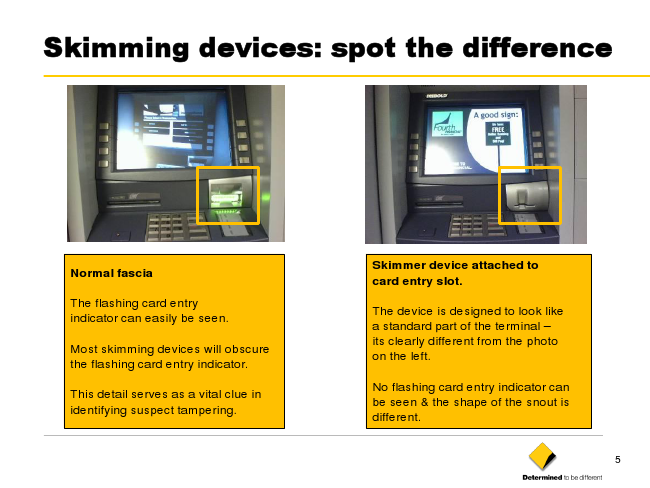
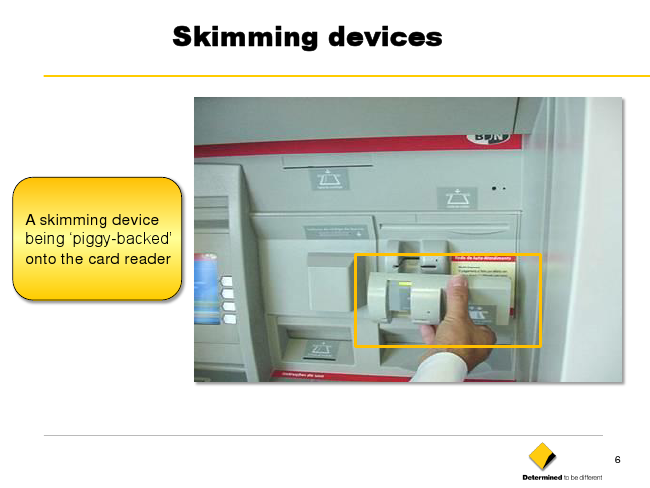
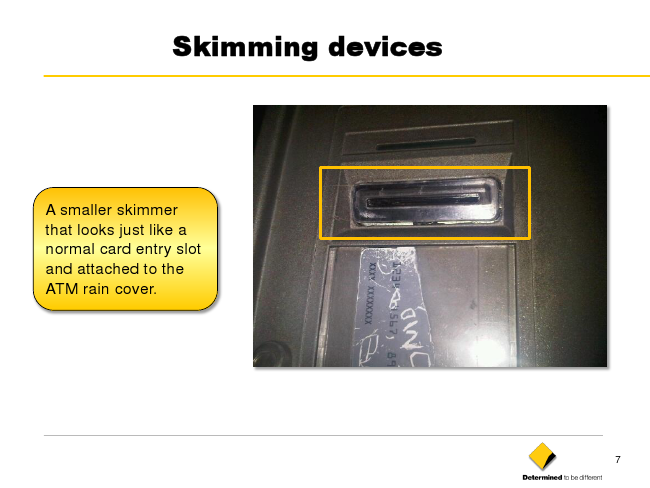
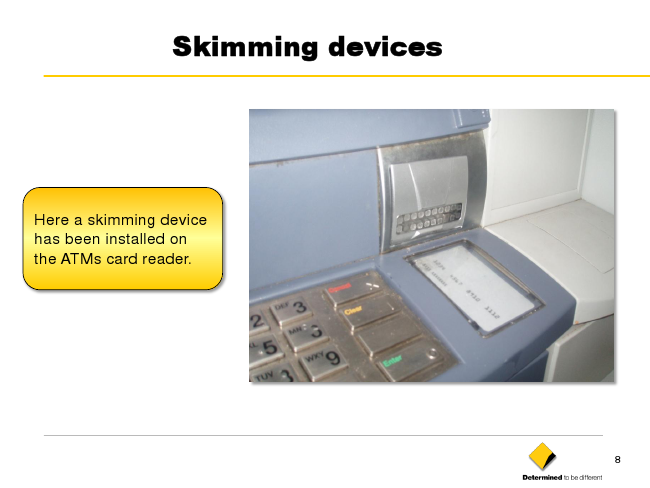
'HACK' Money from ATM..... [ATM Skimming machine]

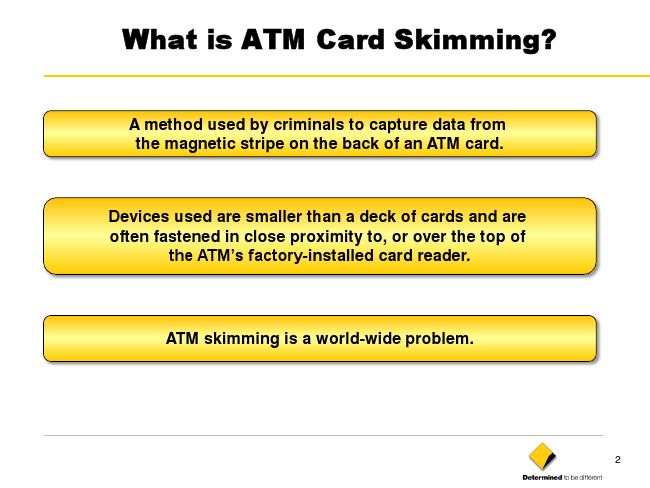
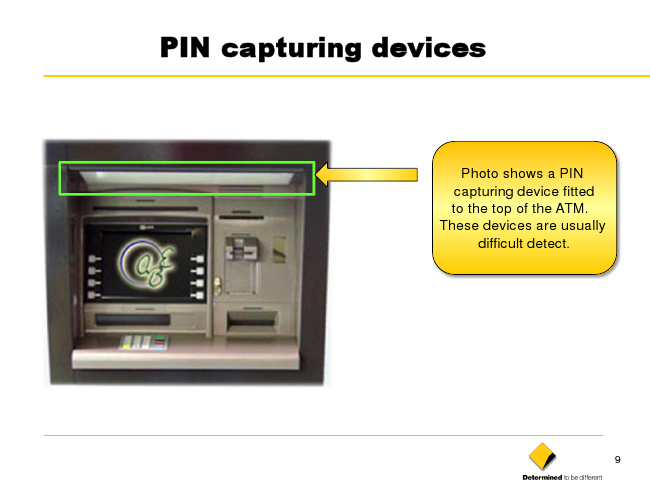
        "ATM skimming is one of the fastest growing criminal activities, where the fraudsters place an electronic device on an ATM to scoop every bit of information from a ATM card’s magnetic strip whenever a customer uses the machine"


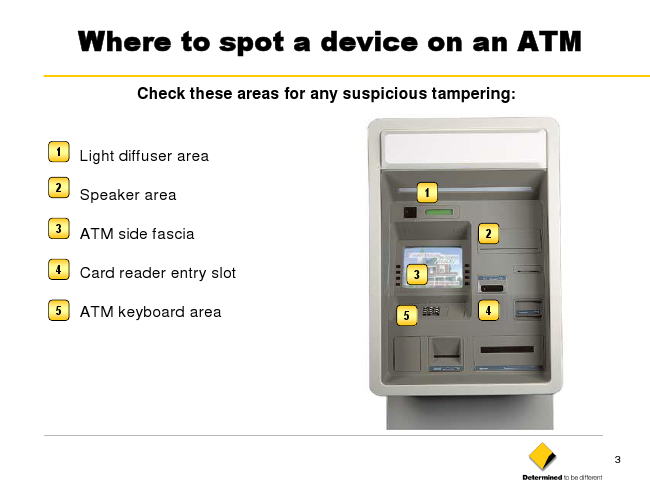
A close-up of an ATM card reader

closer look at the electronics inside of this handmade reader

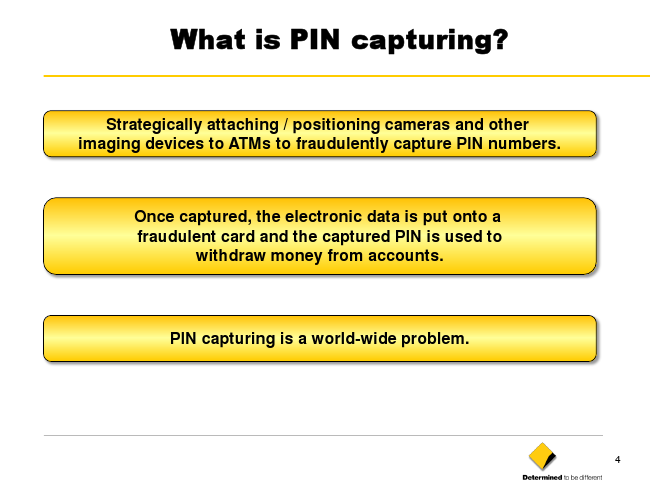
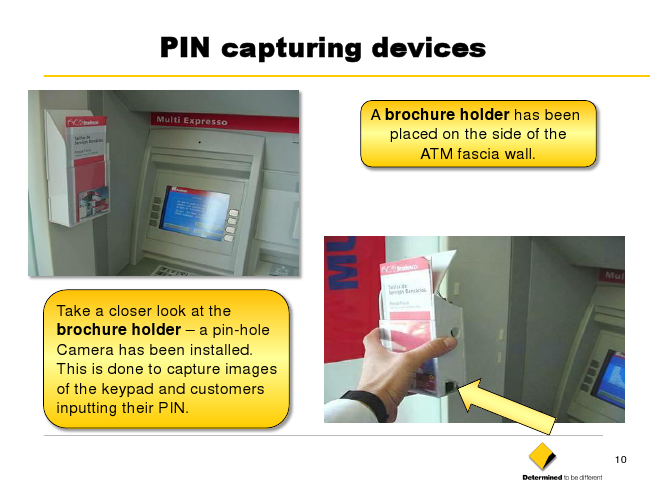
Hidden pin hole camera - Focusing the keypad
Backside of hidden camera for ATM skimmer


      Skimming is the theft of credit card information used in an otherwise legitimate transaction. It is typically an "inside job" by a dishonest employee of a legitimate merchant. The thief can procure a victim's credit card number using basic methods such as photocopying receipts or more advanced methods such as using a small electronic device (skimmer) to swipe and store hundreds of victims’ credit card numbers. Common scenarios for skimming are restaurants or bars where the skimmer has possession of the victim's credit card out of their immediate view. The thief may also use a small keypad to unobtrusively transcribe the 3 or 4 digit Card Security Code which is not present on the magnetic strip. Call centers are another area where skimming can easily occur.
        
       Instances of skimming have been reported where the perpetrator has put a device over the card slot of an ATM (automated teller machine), which reads the magnetic strip as the user unknowingly passes their card through it. These devices are often used in conjunction with a miniature camera (inconspicuously attached to the ATM) to read the user's  at the same time. This method is being used very frequently in many parts of the world, including South America, Argentina Europe, the Netherlands. Another technique used is a keypad overlay that matches up with the buttons of the legitimate keypad below it and presses them when operated, but records or transmits the keylog of the PIN entered by wireless. The device or group of devices illicitly installed on an ATM are also colloquially known as a "skimmer". Recently-made ATMs now often run a picture of what the slot and keypad are supposed to look like as a background, so that consumers can identify foreign devices attached.
        
             Skimming is difficult for the typical cardholder to detect, but given a large enough sample, it is fairly easy for the card issuer to detect. The issuer collects a list of all the cardholders who have complained about fraudulent transactions, and then uses data mining to discover relationships among them and the merchants they use. For example, if many of the cardholders use a particular merchant, that merchant can be directly investigated. Sophisticated algorithms can also search for patterns of fraud. Merchants must ensure the physical security of their terminals, and penalties for merchants can be severe if they are compromised, ranging from large fines by the issuer to complete exclusion from the system, which can be a death blow to businesses such as restaurants where credit card transactions are the norm.

Ref:
 
read more

Thursday, 6 October 2011

The Koodankulam nuclear power plant.... The third generation design.....


Recently a number of people observed a fast near the Koodankulam Nuclear Power Station. This power station consists of two reactor units, each with a generating capacity of 1,000 megawatts. The first unit is ready for fuel loading and can start up in the next three months or so. However the agitation has interrupted the start up activities. After the March earthquake and tsunami in Japan, three reactors suffered serious damage and radioactivity spread to the neighbourhood. Japanese authorities evacuated people living in a 20 kilometre radius from the reactors.
The Fukushima accident has alerted all organisations concerned with nuclear energy development. Prime Minister Manmohan Singh promptly ordered a review of the safety status of all nuclear power units, both in operation and construction. The Nuclear Power Corporation of India (NPCIL) and the Atomic Energy Regulatory Board (AERB), set up a number of task forces to review the safety features of the reactors, risks posed by earthquakes, tsunamis and flooding due to any reason, disconnection of the nuclear unit from the electrical grid system, and such other unusual situations. These reviews have shown that the kind of situation that developed in Japan is not likely to occur in our installations due to adoption of conservative design features and above all absence of the severe intensity earthquake that shook Japan.
As a result of the reviews carried out by NPCIL and AERB, certain additional design features are being implemented in our installations. One of them is providing adequate capacity portable air-cooled diesel generator sets to supply power to essential services, without fail. Another is ensuring that adequate amount of fresh water is available for ensuring cooling of the nuclear fuel.
The Koodankulam nuclear power units belong to the third generation of design evolution, whereas the Fukushima reactors belong to the first generation. Specifically for the purpose of cooling nuclear fuel, when the reactor is shut down, there are four independent systems each with its own diesel generator (of 8 MW), its own pumps and heat exchangers. Normally one such system is adequate. Providing four systems ensures that even if there is a malfunction in one or two systems, the other is available. The level of the diesel generator, its switch gear and controls are several metres higher than the highest tsunami or flood level expected at Koodankulam.
A special feature of the Koodankulam design is the provision of a Passive Cooling System for the nuclear reactor core. The water cooling the reactor transfers its heat to the water in the steam generators. Normally, steam is produced in the steam generators which then drives the turbine generator and produces electricity. After doing work in the turbine, steam condenses into water in the condenser and is pumped back to the steam generator. In an abnormal situation when no power is available to drive these pumps, the hot water in the steam generator flows up to an air-cooled heat exchanger located at a high level on the outside of the reactor building. Due to the height difference the hot water rises up and cold water flows down to the steam generator. This is called the thermo siphon effect and does not need a pump. This feature was incorporated in the Koodankulam design at the specific instance of India. Koodankulam reactors are the first such reactors to have this passive cooling feature.
A further feature in the Koodankulam design is called a 'core catcher'. In the event of an accident and the molten nuclear fuel were to breach the reactor pressure vessel, it falls on to a matrix containing a large amount of neutron absorbing substances (such as boron). On mixing with this material, the nuclear fuel is rendered incapable of starting a nuclear chain reaction. Only the latest design provide for this safety back up system.

Many of the people living around Koodankulam are engaged in fishing activities. There are fears that the reactor might affect their means of livelihood but fishing activities at Kalpakkam and Tarapur are going on normally without any hindrance. In fact quality of life and standard of living has improved in these areas.
Some who oppose nuclear energy on principle say 'let us use solar and wind energy'. At present solar energy costs about Rs 20/kWh, wind energy may cost Rs 10/kWh and is available only for about 20 or 25 per cent of the time when wind blows. Our nuclear power stations are selling energy at Rs 1/ kWh at Tarapur, Rs 3/kWh at Kaiga and the newer units. Power from Koodankulam will be well below Rs 3/kWh. We all know how Tamil Nadu and the other southern states are struggling with power shortages. The two units of Koodankulam will supply about 1000 MW to Tamil Nadu, without the hassle of getting coal from Orissa or overseas.


Ref : http://www.power-eng.com/news/2011/10/1513708770/koodankulam-is-safe-bet.html

Related Posts:


posted by Earthian alone at Log in to ME .... - 2 days ago
We where known that Japan's Fukushima Daiichi Nuclear Power Plant accident was due to the damage in coolent supply line and caused core melt down. That was first rated as INES-5 accident (Interna...
read more